






Have you recently ditched your old Teflon pans and made the switch to stainless steel cookware? Firstly, your health - and the planet - thanks you!
Cooking with stainless steel means picking durable, safe utensils free from harmful chemicals. Ultra-resistant and PFAS-free, stainless steel can enhance all your dishes - if you know how to use it properly.
Ready to master your stainless steel pans? From testing the water drop to seasoning, this article shows you how.
It’s really not just for Michelin-star chefs, and after a little practice, cooking with a stainless steel pan will feel effortless for years to come.
First use of a stainless steel pan
Before you get going, set yourself up for success by picking up the right habits:
- Give your pan a thorough wash in hot, soapy water to remove any traces from manufacturing or transport residues.
- Always dry your pan to prevent limescale marks.
- Don’t worry if your pan sticks a little at first - you’ll soon get the hang of it with the right techniques.
Should you season a stainless steel pan?
You’ve probably heard about seasoning cast iron and steel pans to protect the coating and boost non-stick performance. It involves coating them with a thin layer of grease for a little extra protection. But stainless steel doesn’t necessarily need it.
That said, some cooks like to pre-season the pan to minimise the risk of food sticking to the coating, especially when they first start to use stainless steel.
❌ Here’s why we recommend not seasoning your stainless steel pan:
- With a few simple steps, your food will not stick during cooking.
- You won’t be able to wash your pan in the dishwasher, as it will strip away the protective layer of grease.
- Stainless steel is naturally rustproof and cannot corrode, so you don’t need to protect it.
#1 Preheat your stainless steel frying pan thoroughly
Preheating your pan is crucial - it’s the key to cooking without sticking. Stainless steel should be hot, but not scorching. Whatever you do, don’t skip this step!
- Place your empty pan over medium heat or at ⅔ power.
- Leave it to heat for 2 to 3 minutes.
- Do not add the oil or butter straight away: wait for the perfect moment, the Leidenfrost effect. ⤵️
#2 The water drop test: Leidenfrost effect
The water drop test, also known as the Leidenfrost effect, allows you to determine whether your stainless steel pan is ready to cook your food.
This physical reaction, discovered by scientist Leidenfrost, is a phenomenon of thermal insulation that occurs when a liquid comes into contact with a surface heated to over 150°C.
In simple terms:
- Sprinkle a few drops of water into your empty, heated pan.
- If they evaporate immediately: your pan is not hot enough.
- If the water droplets form a puddle: extend the heating time.
- If the water droplets form little beads across your pan, you're at the right temperature! Now it's time to add your fat and cook your food.
 https://www.youtube.com/watch?v=TljOMpQDCkQ
#3 To add fat... or not!
Once your stainless steel pan is ready, turn the heat down to medium. Add a splash of oil or a knob of butter (only if your dish calls for it of course).
- Vegetables, eggs, fish or fruit: a little fat is recommended to prevent sticking.
- Red or white meat: no need to add anything. Their own fat is enough to create a delicious, non-stick crust.
✨ Top tip: if your oil starts to smoke, it means your stainless steel pan is too hot! Turn down the heat slightly to preserve the flavours...and your pan.
#4 Let your food cook before stirring it
Did your sautéed potatoes end up as mash?
Constant stirring isn’t the way to go with stainless steel. Your food needs to form a light caramelised crust before it releases naturally.
Follow these steps:
- Add food only when the pan is hot and lightly oiled.
- Sear over medium heat for a few minutes.
- Stir or turn only when food releases easily.
Stainless steel, not just for chefs!
Cooking with stainless steel isn't just for the pros!
Now that you’ve got the basics, here are some extra tips to cook like a chef… without actually being one.
Do not overload your stainless steel pan
It's tempting to cook everything at once, but food in a stainless steel pan needs space.
Always match your pan size to the recipe - or cook in batches. Crowding the pan can ruin the cooking, leaving food burned and stuck.
Cook gently in your stainless steel pan
No need to crank the heat or use the ‘boost’ setting with a stainless steel pan. Its excellent thermal conductivity means it heats up quickly on its own.
If the heat is too high, you risk burning your food or damaging your pan.
✨ The golden rule: medium to low heat for even, controlled cooking, especially for stews or dishes that require longer cooking times.
Use of stainless steel for all types of cooking
Searing, braising, simmering, deglazing - stainless steel handles it all! Even fried eggs won’t stick if you follow the right steps.
Searing meat or fish
- Once your pan is hot, place your piece of meat in it.
- Sear it at a high temperature on each side. A beautiful caramelised crust will form. Your piece of meat or fish will remain tender in the centre.
- Set aside your meat and deglaze the juices left in the bottom of your pan with white wine or stock to make a rich, flavourful sauce.
➡️ Tip: rest your meat at room temperature for about 30 minutes before cooking. This will give it a beautiful colour and make it irresistibly tender.
Cooking perfect veggies
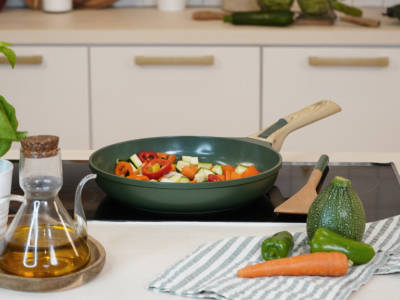
Stainless steel is a dream for sautéing veg - whether you like them crunchy or tender. Carrots, broccoli, mushrooms, courgettes - whatever you fancy - will caramelise beautifully over a medium heat while keeping their bite.
Just be sure not to stir them too often to avoid a ‘mashed’ effect.
Simmering food in a stainless steel pan
You can absolutely simmer in stainless steel. Just turn the heat down low, pop the lid on, and let it do its thing. Perfect for rich sauces, curries, melt-in-the-mouth veg or tender pulled meat.
Discover delicious sauces by deglazing pan juices
Cooking juices are those tasty little caramelised bits of meat or veg left at the bottom of your pan after searing.
Add a splash of wine, stock or cream and those caramelised juices will lift straight off the pan, transforming into a rich, flavour-packed sauce for your dish.
✨ The added bonus? A good deglaze not only makes your sauce tastier, it also saves time cleaning up!
https://www.youtube.com/watch?v=TljOMpQDCkQ 
Introducing The Marvellous Nickel-Free Stainless Steel Collection
Cooking with stainless steel cookware might take a little getting used to, but once you do, it feels like a return to honest, healthy cooking at its best.
Performance, durability and peace of mind - that’s what you get with our new Marvellous nickel-free stainless steel collection. Once you try it, you won’t look back!
3-ply stainless steel SteelGreen®
Steel Green® triple-layer stainless steel is a high-end, cutting-edge cooking technology:
- Nickel-free stainless steel, crafted especially for cooking: for precise results without the worry of nickel migration – a metal often linked to allergies.
- Recycled aluminium core: for even heat distribution
- Special ferritic stainless steel: compatible with induction hobs for perfect cooking performance.
Finally, colourful stainless steel cookware you’ll love!
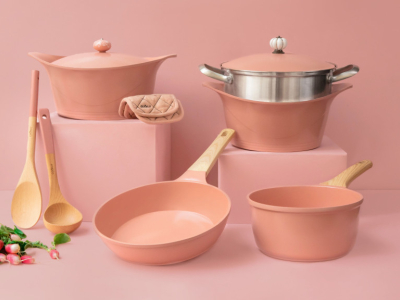
Who said stainless steel has to be grey? At Cookut, our Marvellous range comes in six vibrant colours to brighten your kitchen. Plus, you can mix and match perfectly with our Incredible and Fabulous ranges!
Design and performance finally combined for even more joy in the kitchen.
Healthy and environmentally friendly cuisine
Stainless steel lets you cook:
- Without PFAS, PFOA, nickel, or any other controversial substances.
- On all hobs, including ovens and induction hobs.
- With sustainable utensils.
Bon appétit !