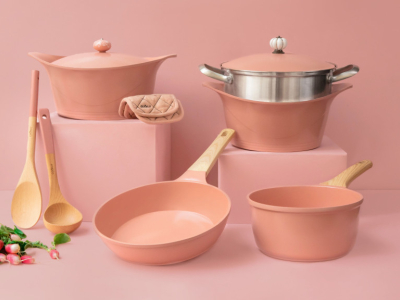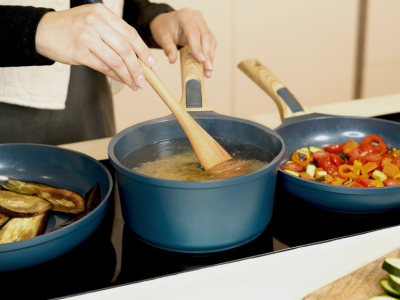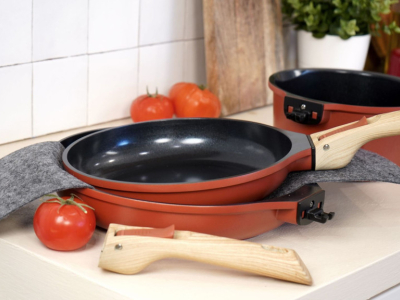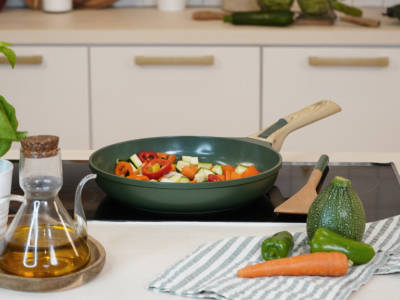







With so many coating options for frying pans and saucepans, it can be tricky to know where to start. From stainless steel, ceramic, cast iron and non-stick, each material has specific features and advantages.
Are you looking for the best pan for your health? Or do you want non-toxic cookware that's easy to clean?
Whatever you’re in the market for, Cookut has created a guide to help you find the best option for you!
Tips for choosing cookware coating
Performance and durability
If you're investing in a new frying pan or saucepan, you ideally want it to last several years. That’s why thinking about the performance and durability of your cookware coating is so important. Things to consider include:
- Scratch and wear resistance
- Durability and maintenance
- Compatibility with heat sources
➡️ Top tip: for a long-lasting frying pan or saucepan, choose a coating that’s sturdy, easy to maintain and also suited to your cooking style. Don’t forget that safe cooking and your health are essential factors too.
Health and safety: Beware of toxic coatings
When you're cooking, it’s not just about delicious food—you want healthy, nourishing meals, too! Sadly, not all cookware coatings are made equal. While some materials are safe and non-reactive, others release harmful substances when exposed to heat or wear. From toxic chemicals to endocrine-disrupting compounds and environmental pollutants, certain materials bring unwelcome risks to the kitchen. So, how can you avoid these hazards and make sure your cookware is safe and effective?
Coatings for frying pans and saucepans
Stainless steel pots and pans
Stainless steel is a kitchen staple for home cooks and professional chefs alike. Renowned for its robustness and food neutrality, it can be used for all types of cooking...as long as you know how to use it properly!
✅ The benefits of stainless steel:
- Ultra-resistant: It’s scratch, impact, and corrosion-resistant.
- Reliable and safe: Stainless steel is inert, which removes the risk of particles or harmful substances coming loose in your food.
- Compatible with all types of hob: Gas, induction, glass ceramic, stainless steel is suitable for all types of hob.
⚠️ The drawbacks of stainless steel:
- Isn’t non-stick: Without enough fat, food tends to stick to the pan, especially at the start of cooking.
- Poor heat conductor: Stainless steel alone heats unevenly. It is often combined with an aluminium or copper base to improve heat diffusion.
- Takes a bit of practice: To prevent sticking, stainless steel pans need to be fully heated before introducing fat.
Cast iron pots and pans
Cast iron is the secret to slow, gentle cooking. A favourite for lovers of traditional cooking, it retains heat and slowly diffuses it for dishes that are simmered to perfection. It comes in two forms: raw cast iron and enamelled cast iron.
✅ The benefits of cast iron:
- Super sturdy: When looked after well, a cast iron frying pan can last a lifetime.
- Compatible with all heat sources: Gas, induction, oven...it cooks up a storm anywhere!
- Uncoated cast iron: It doesn’t release any chemical substances into the food.
⚠️ The drawbacks of cast iron:
- Heavy: The weight of a cast iron frying pan or saucepan can be an obstacle to everyday use.
- Raw cast iron is sensitive to moisture: Without an enamel coating, it is susceptible to rust if not properly dried after washing.
- Special care: Natural cast iron must be sealed (oiled and heated) to retain its non-stick properties.
Pans and saucepans with PTFE coating
PTFE (polytetrafluoroethylene), better known as Teflon, is a widely used non-stick coating. It allows you to cook without sticking and helps limit the use of fats. Practical and affordable, it’s used in kitchens far and wide…just be careful how you use it and how long it lasts.
✅ The benefits of PTFE coating:
- Non-stick: Great for fat-free cooking and preventing food from sticking.
- Easy to clean: A simple wipe with a sponge is all it takes. It's usually dishwasher-safe too.
- Fast, even cooking: Combined with an aluminium body, it spreads heat evenly.
⚠️ The drawbacks of PTFE coating
- Heat sensitivity: At temperatures above 260°C, PTFE begins to degrade and can release potentially toxic vapours, in particular PFAS or ‘eternal pollutants’.
- Fragility: The coating can be damaged over time. Steer clear of metal utensils or abrasive cleaning!
- Limited lifespan: Even if you take good care of it, a PTFE frying pan generally needs to be replaced every few years.
Ceramic-coated frying pans and saucepans
Ceramic coating is an alternative to PTFE that has gained popularity with lovers of healthy cooking. Appreciated for its non-stick and eco-friendly properties, it allows you to cook with little or no fat, while withstanding high temperatures safely.
✅ The benefits of ceramic coating:
- Natural non-stick: Allows cooking without sticking. Great for lighter cooking.
- PTFE and PFOA free: Does not release potentially toxic substances at high temperatures.
- Easy care: Dishwasher-safe and requires no special maintenance.
- Modern aesthetics: Its smooth, often clear appearance gives cookware an attractive look.
⚠️ The drawbacks of ceramic coating
- Sensitive to impact: A thermal shock or a strong blow can weaken or crack the coating.
- Less durable: Although heat-resistant, it can wear down over time and lose its non-stick properties.
What’s the best pan coating for your health?
PFAS-free pots and pans
PFAS (per- and polyfluoroalkyl substances), often referred to as "forever chemicals," are synthetic compounds commonly found in non-stick coatings like PTFE. Why is PFAS a concern? It’s extremely resistant to breaking down in the environment and can accumulate within our bodies over time.
Why avoid PFAS? At high temperatures, some PTFE-containing coatings can release harmful gases. PFAS are suspected to have adverse health effects, including their role as endocrine disruptors and their potential to impact the liver and immune system.
Pots and pans without toxic coatings: how to choose?
How do you spot non-toxic cookware? Start by looking for the words ‘PFOA-free, PFAS-free’ on the label or in the product description. Beware of non-stick pans that don't specify the composition of the coating!
If you want to cook with freedom and peace of mind from potentially harmful substances, there are some safe bet options. Stainless steel, natural cast iron and ceramic are all naturally PFAS-free and offer a host of different benefits, depending on your cooking style.
Non-stick, non-toxic cookware: does it exist?
This is the big question! Is it possible to have a non-stick pan AND one free of controversial substances? The answer is yes, with a few factors to be aware of.
The best alternatives today are:
- Ceramic frying pans: PFAS -and PFOA-free, they allow you to cook with little fat.
- Cast iron pans: When properly cared for, cast iron develops a natural patina that becomes non-stick over time.
- New generation of PFAS-free non-stick coatings: Many brands are developing safer coatings, often based on minerals or non-fluorinated polymers.
Our tips for long-lasting cookware
Solid pots and pans are great. Keeping them in perfect condition for as long as possible is even better! Good maintenance preserves non-stick properties, prevents premature wear and ensures they always cook to perfection.
➡️ After cooking let your frying pan or saucepan cool down before running it under water to avoid thermal shock.
➡️ Use a soft sponge and a little washing-up liquid. Ditch the metal scrapers, which could scratch the surface.
➡️ Specific care depending on the material:
- Stainless steel: A little white vinegar or bicarbonate will help remove cooking marks.
- Cast iron: No harsh detergents! Simply rinse in hot water before oiling lightly.
- Ceramic: Wash by hand to avoid damaging the coating.
✨ If you'd like to find out more, we've put together a complete guide to caring for your cookware!
Cookut frying pans and saucepans: safe and efficient
Now that you know about different coatings and their impact on health and sustainability, one question remains: which brand should you turn to for safe, sustainable cooking? That's where Cookut comes in!
Non-stick pans without toxic coatings
It's possible to cook without worrying about potentially harmful substances. Cookut frying pans and saucepans are guaranteed free from PFAS, BPA, PTFE, cadmium and nickel.
No more controversial compounds: here, only performance counts.
✅ Safe ceramic coating
✅ High heat resistance
✅ No health risk
Recycled cast aluminium: light and clever
If you find traditional cast iron too heavy and difficult to handle, you'll love Cookut frying pans and saucepans! Thanks to their recycled cast aluminium alloy, they combine durability and lightness, while guaranteeing even heat distribution.
Choose healthy, sustainable cooking with Cookut
Ready for a non-stick frying pan or saucepan that's safe for your health and environmentally friendly? Cookut is here for you!
Bon appétit!