






- PFAS, PFOA, PTFE, forever chemicals: what are they?
- Definition of PFAS, PTFE and PFOA
- Why are they called forever chemicals?
- PFAS: their role in non-stick coatings
- Where can PFAS chemicals be found?
- What are the dangers of PFAS?
- An invisible but persistent contamination
- What are the risks of PFAS to humans?
- PFAS and the environment: a disastrous impact on the planet
- Where can PFAS be found in the kitchen?
- Non-stick frying pans and saucepans: why manufacturers use PFAS.
- Other sources of PFAS in the kitchen
- How do you know if a utensil contains PFAS?
- How do I choose PFAS-free cookware?
- Which PFAS-free utensils do I choose?
- What are the alternatives to non-stick coating with PFAS?
- PFAS-free frying pans and saucepans: a healthy, sustainable solution
- The Incredible Cookut PFAS-Free Casserole
- PFAS-free wooden kitchen utensils
- How to cook without PFAS on a daily basis
- Check labels and certifications
- Replace your utensils gradually
- PFAS in the UK: Where Do We Stand?
The utensils and accessories we use in our kitchens daily play a huge role in shaping not only our health and that of our loved ones but also the health of the environment. However, it’s important to be cautious - convenient non-stick coatings come with hidden risks. They may contain controversial chemicals known as PFAS.
This article looks at what ‘forever chemicals’ are and how they impact our health. Plus, why choosing PFAS-free cookware is a good move for both the environment and your wellbeing.
PFAS, PFOA, PTFE, forever chemicals: what are they?
Per- and polyfluoroalkyl substances, more commonly known as PFAS, are a large family of several thousand synthetic chemical compounds. They have been used in industry and consumer products since the 1950s.
Thanks to their non-stick, waterproof and heat-resistant properties, these substances quickly become a part of our daily lives.
The problem? Forever chemicals are hugely persistent in the environment , with a tendency to build up in our bodies over time. This accumulation has been linked to serious health issues, including numerous diseases.
Definition of PFAS, PTFE and PFOA
The PFAS family includes two sub-families:
- Non-polymers: Among these, perfluorooctanoic acid (PFOA) and perfluorooctanesulfonic acid (PFOS) are the best-known compounds. Resistant to degradation, they are detectable in the environment and the food chain. Classified as group 1 carcinogens by the ARS since 2023, they have a direct impact on health and are largely banned in most countries.
- Polymers: These include PTFE (polytetrafluoroethylene), a fluoropolymer better known as Teflon®, which is still used in cookware and cooking utensils.
Why are they called forever chemicals?
PFASs are virtually impossible to break down. Purely man-made, once they are released into the atmosphere, they diffuse into water, household waste, industrial fumes, and find their way into the food chain. They can persist in the environment for centuries.
PFAS: their role in non-stick coatings
In the kitchen, PFAS chemicals are mainly found in non-stick coatings on frying pans, woks, and saucepans. The most common of the chemicals, PTFE, allows for easy cooking without food sticking. However, above 260°C, it can release harmful gases. To stay safe, avoid overheating empty non-stick pans and try not to leave utensils sitting in them while cooking.
PFOA, long used for frying pan coatings, has been banned throughout Europe since July 2020. A carcinogen and endocrine disruptor, it may still be present in old utensils or in products imported from areas where regulations are more flexible. To avoid it, it’s important to stay cautious.
Where can PFAS chemicals be found?
Their inability to break down, coupled with the widespread use of PFAS in everyday products globally, means exposure is almost impossible to escape.
As well as kitchen utensils and cookware, PFAS can be found in :
- Food packaging
- Water-repellent textiles
- Cosmetics
- Fire-fighting foams
What are the dangers of PFAS?
An invisible but persistent contamination
PFAS micro-particles are invisible, odourless, and incredibly tough to break down. These particles slowly make their way into everyone’s lives, even reaching unborn babies and infants. Once PFAS enter the body, they stick around for years, building up over time.
Sadly, there’s currently no effective way to remove them from the human body.
What are the risks of PFAS to humans?
In the short term, the effects of PFAS go virtually unnoticed. However, occasional exposure to high doses, particularly by breathing fumes over a damaged pan, can cause flu-like symptoms (headaches, fever, dizziness, aches and pains, etc.). This illness is known as ‘Teflon flu’.
Researchers are most concerned about the long-term effects. Repeated exposure over several years can cause several adverse health effects:
- Disturbances to our hormonal system.
- Impaired fertility in men and women.
- Lower birth weight in newborns.
- Alteration of the immune system.
- Increased blood cholesterol levels.
- Increased risk of certain cancers, particularly of the kidney and testicles.
PFAS and the environment: a disastrous impact on the planet
PFAS are a major threat to all ecosystems. Their presence has been detected at every level: water, air and soil. These particles have even been found where there is no human activity, and in the most remote areas of the planet.
The entire food chain is contaminated and will be for several centuries, making this one of the greatest environmental challenges of our time.
Where can PFAS be found in the kitchen?
Non-stick frying pans and saucepans: why manufacturers use PFAS.
PFASs have been marketed by the major brands of frying pans and saucepans since the 1950s.
At the time, it was something of a revolution in the world of cooking. The non-stick coating made it possible to cook without fat. Plus, it was easy to clean. As well as being practical for the consumers, it was also cheap for manufacturers to produce.
Other sources of PFAS in the kitchen
The coatings on frying pans and saucepans are not the only contaminants though. PFAS are everywhere and can be found in:
- Tins and plastic film for storing food.
- Certain silicone moulds.
- Plastic utensils and chopping boards.
- Anti-fat or water-repellent food packaging (cardboard boxes, fast-food packaging, etc.)
How do you know if a utensil contains PFAS?
MUnfortunately, this information is always readily available. Here's how to recognise a product containing PFAS:
- Accessories containing Teflon® or with a non-stick coating.
- Products labelled ‘PTFE’.
- Cheap products with no details of their composition.
How do I choose PFAS-free cookware?
Transparency is essential if you want to choose your kitchen utensils wisely. Opt for brands that are committed to the environment and actively communicate on the subject.
Look closely at product descriptions and the detailed compositions. Give preference to the words ‘0% PFAS’, ‘no chemical coating’, ‘mineral coating without PTFE’ or ‘no PFAS added’.
Finally, choose durable, safe materials such as cast iron, stainless steel, ceramic and borosilicate glass.
Which PFAS-free utensils do I choose?
What are the alternatives to non-stick coating with PFAS?
There are several options for replacing PTFE linings.
- Stainless steel: durable and resistant, but often more complex if you're new to stainless steel.
- Cast iron: also durable and ideal for simmering and slow cooking. Can be heavy and tricky to handle.
- Mineral ceramic coatings: naturally non-stick and non-toxic, though fragile compared to PTFE-based coatings.
- Borosilicate glass: great for baking or food preservation.
PFAS-free frying pans and saucepans: a healthy, sustainable solution
Choosing to protect your health by reducing exposure to PFAS also means opting for a more environmentally responsible frying pan or saucepan. What’s more, by renewing your cookware less often, you reduce your waste. A good move for the planet and your finances.
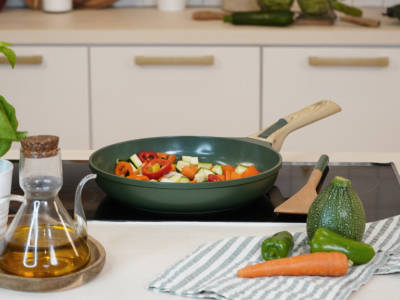
Discover our range of Cookut frying pans and saucepans, guaranteed free from PFAS and controversial substances.
The Incredible Cookut PFAS-Free Casserole
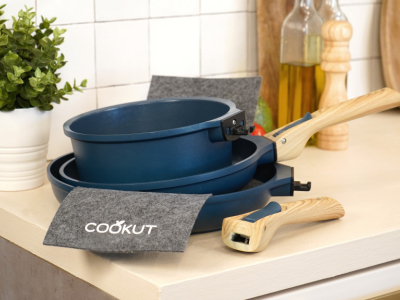
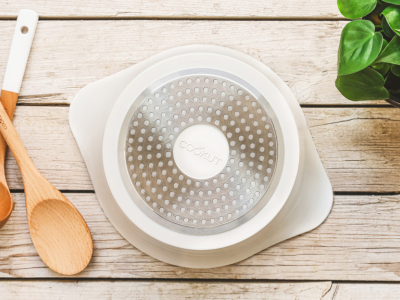
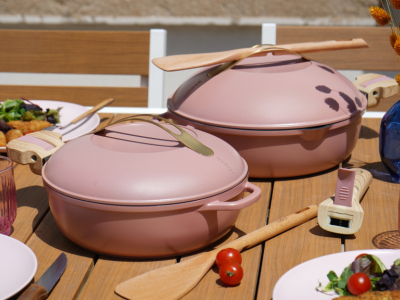
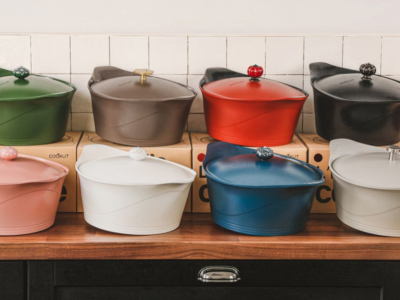
Do you love a good casserole? Allow us to introduce The Incredible Cocotte - customisable and ultra-light. It has a recycled metal core and a PFAS-free mineral coating. It’s also free of harmful substances, and is made by vitrifying silica (the main component of sand), along with water at a high temperature. This means you can cook confidently, knowing there are no controversial petroleum-based materials in your cookware.
PFAS-free wooden kitchen utensils
Making an informed choice about your cookware is important, but don't neglect your spoons, ladles and spatulas! These accessories, sometimes of poor quality, can also contain PFAS or other toxic compounds.
Wood is a sustainable ally in your transition to a toxic-free kitchen. For a perfect match with your saucepans, take a look at our wooden utensil set or the spoon and ladle set!
How to cook without PFAS on a daily basis
Check labels and certifications
Are you ready to replace your frying pans and saucepans? But choosing between all the labels and certifications on the market is a little overwhelming? Here are a few tips to help you choose:
- The words ‘No PFAS’, ‘No PTFE’, ‘No PFAS added’ are the big ones to look for.
- GOTS or OEKO-TEX is the label to look out for for kitchen textiles: tablecloths, towels, etc.
Replace your utensils gradually
Of course, replacing all your cookware at once can be expensive. It’s a good idea to replace things over time, thinking about how often they’re used and how worn they currently are.
Here's a plan for making a smooth and easy transition in the kitchen:
- Start by getting rid of pans with scratched non-stick coating, especially if it's the one you use most and it's already several years old.
- Replace worn silicone moulds with glass ones.
- Gradually replace your plastic accessories with wooden ones.
As you go along, you’ll soon be rid of all accessories and dishes containing plastic. This means You're on your way to a natural, environmentally-friendly kitchen that's 100% PFAS-free!
➡️ Discover our tips for changing your frying pans and saucepans!
PFAS in the UK: Where Do We Stand?
PFAS, or "forever chemicals", are under growing scrutiny in the UK due to their potential health and environmental risks. While some countries have begun banning PFAS in consumer products, the UK has so far taken limited steps - mainly targeting firefighting foams.
There’s no full ban yet on PFAS in everyday items like cosmetics, textiles, or non-stick cookware. These products remain on shelves while regulators weigh up the need for action and the time industries need to adapt.
For now, it's down to consumers to stay alert. Choosing brands that are upfront about what’s in their products can help push the market toward safer alternatives.